
Persian Rug Cleaning
in Manhasset
Deep expertise in Persian rug construction and dyes, cleaned according to region and fiber.
Arrange a pickup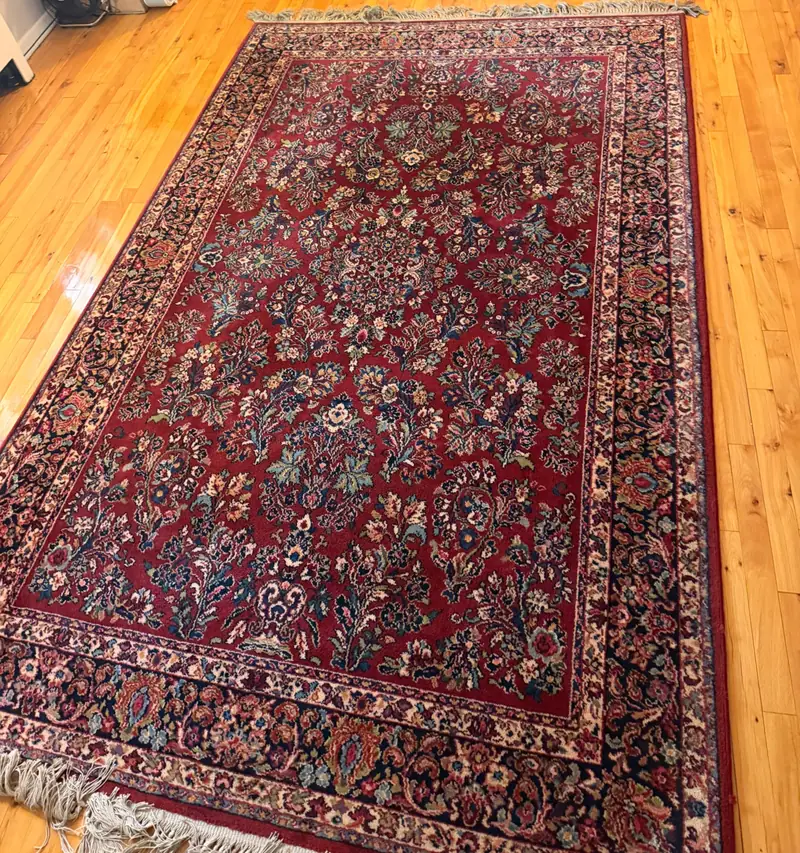 PHOTOGRAPHED BY OUR TEAM
Care begins with
understanding.
Persian rugs are among the world's most coveted textiles, each reflecting the tradition of its region, from the intricate florals of Isfahan to the bold geometry of Heriz. Our cleaning approach accounts for the specific knot density, dye type, and wool or silk composition of each Persian piece. We work to lift embedded soil and bring back color while preserving the rug's character.
We discuss the condition, recommended treatment and expected outcome with you. The appropriate method is selected after inspection; not every treatment is suitable for every rug.
Persian Rug Cleaning in Manhasset
Single family houses hold 84 percent of homes here, so a big Persian usually leaves from an upstairs room down a staircase, rolled tight; a narrow turn on the way down is worth a note on the tag, next to the rug's width and length. Persian rugs are washed according to their weave and region, a fine city rug more gently than a sturdy village one, and every dye is tested before water touches it. If the rug has silk highlights, mention them, and any worn ends or old repairs are noted with you before the wash. The weave decides how the wash is run: a coarse village piece such as a Heriz is heavy but forgiving; a finely knotted city rug has more surface in the same footprint and takes a longer rinse, and a piece with silk in the field or the border takes the least water of all. Where the dyes hold, the rug goes into a full immersion hand-wash with the natural dyes stabilized first; rinsing runs through several changes of water, since a dense pile clings to soap the way a heavy coat clings to rain, and soap left in the pile resoils the wool in a few weeks. Drying is flat, with air drawn over the face rather than the rug hung up, and the fringe is washed, combed and finished by hand after everything else is done. What the wash changes shows first at the borders, where the pile has not been walked on and still holds the depth of color the field is measured against; the field comes back toward it as the soil lifts, and that comparison, border against field, is the true measure of what a wash has done. Under the dining table where a Persian so often sits, what meals leave behind collects in the pile: wine, oil, the crumbs that sift into the pile and sour there, which is where smells blamed on the room come from. Write down what has been spilled and what was tried on the stains, since supermarket stain products can fix a wool stain in place or move a dye, and a spill that was blotted and left alone responds far better than one treated twice at home. Old creases from years in folded storage are coaxed out by letting the rug relax and drying it flat, though a deep fold rarely vanishes entirely, and we say beforehand how much of it will remain.
- 84%single family houses
- 49%built before 1940
- 82%owner occupied
A careful
consideration.
- 01Region-specific cleaning protocols
- 02Natural dye stabilization
- 03Full immersion hand-wash
- 04Multi-stage rinsing
- 05Flat drying with air circulation
- 06Hand-finished fringe cleaning
Time for a closer look?
- Color fading from sun exposure
- Deep-set soil in dense pile
- Fringe discoloration
- Food or beverage stains
- Pet-related damage
- Dust mite accumulation
Let's care for
something remarkable.
A favorite piece. A family heirloom.
A room that feels like you again.