
Pet Stain & Odor Removal
in Long Island City
Enzyme treatments that work deep into the fibers to break down pet stains and odors.
Arrange a pickup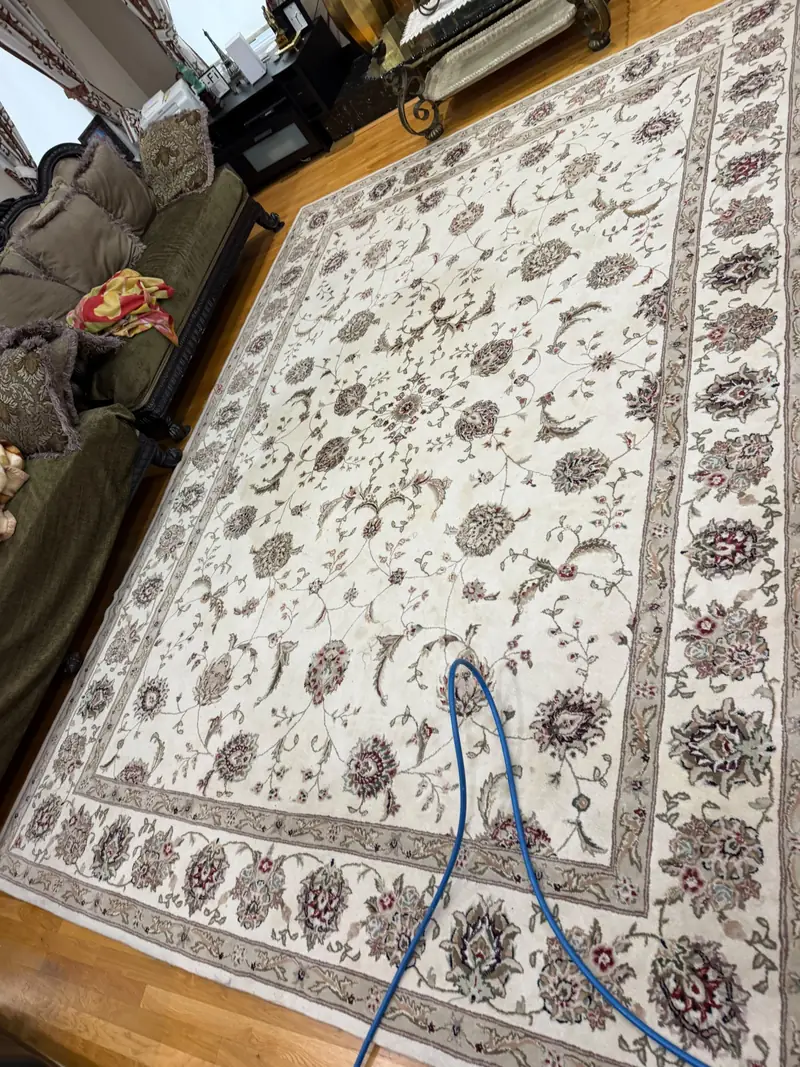 PHOTOGRAPHED BY OUR TEAM
Care begins with
understanding.
Pet accidents are one of the most common and challenging rug issues. Urine, in particular, penetrates deep into the pile, foundation, and even the floor beneath. Surface cleaning alone cannot resolve the problem. Our advanced enzyme-based treatments break down uric acid crystals, the source of lingering odor. Combined with deep sanitization and controlled drying, we address the stains and odors that surface cleaning leaves behind. We tell you before we start what can realistically improve.
We discuss the condition, recommended treatment and expected outcome with you. The appropriate method is selected after inspection; not every treatment is suitable for every rug.
Pet Stain & Odor Removal in Long Island City
Floors in newer buildings, which hold 69 percent of homes in Long Island City, are often engineered wood or laminate, and both can swell at the seams where urine or water sits. Urine that passes through a rug reaches the pad and then the floor, so take the rug off a fresh accident, let the floor dry and blot the rug with paper towels instead of rubbing it. If the accident is older, tell us how old it is and where it happened; we find the rest under UV light. Where urine has changed a dye, the new color stays, and you hear about it before work begins. Replace a pad that has soaked up urine. The treatment itself is mapped before it is done: under UV light the salts an accident leaves trace the whole path the moisture took, often further than the visible spot, and the treatment follows the map rather than the stain. An enzyme solution worked into the affected area breaks down the crystals of uric acid, the substance that holds the smell and gives it up again every time the rug takes up damp from the air; deep flushing carries the debris out of the rug instead of through it; an antimicrobial pass goes where the contamination reached; and drying is controlled so the residue cannot wick up to the surface while the rug dries, which is how a spot that seemed handled reappears a week later. An odor verification test at the end says whether the rug is done or owes another pass, and you hear the answer straight. What the wash cannot do is give back the color urine has already altered, which is why that is said first, before anything is scheduled. Until the pickup, blot with towels and cool water and skip the scented sprays, which mask for a day and set what they touch. Say which animal and roughly when, since cat urine and dog urine differ in strength and in how far they travel, and a rug that has taken repeated accidents in one corner needs the corner treated through the foundation rather than the surface. Keep the rug away from a radiator while it waits for the pickup, because heat sets what a spill has left behind.
- 60%of homes in elevator buildings
- 20%built before 1940
- 18floors in the median home's building
A careful
consideration.
- 01UV light stain mapping
- 02Enzyme-based uric acid treatment
- 03Deep fiber flushing
- 04Antimicrobial sanitization
- 05Controlled drying to prevent wicking
- 06Odor verification testing
Time for a closer look?
- Visible urine stains
- Persistent ammonia odor
- Repeated pet marking
- Vomit or fecal staining
- Discoloration around stain
- Bacterial contamination
Let's care for
something remarkable.
A favorite piece. A family heirloom.
A room that feels like you again.